
29th September is Michaelmas Day, celebrating the feast of St Michael the Archangel who was patron saint of sea/maritime lands, ships/boatmen, horses/horsemen. Apparently, he hurled Lucifer from heaven for his treachery — so an impressive fella. But Michaelmas is also sometimes called Goose Day, reportedly because Elizabeth I was eating goose when news of the Armada defeat reached her.
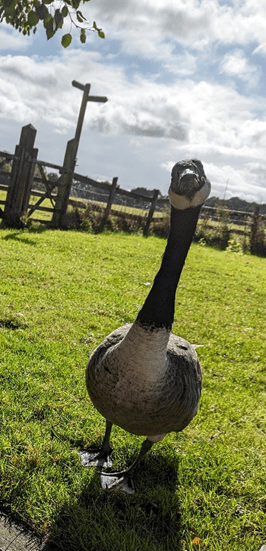
Henceforth it was thought that eating goose at Michaelmas brought good luck for the rest of the year. This caught my attention because I have recently encountered these fascinating fowl at close quarters. In early May, four tiny goslings waddled into our garden. A local walker recalls seeing a family group being spooked, parents flying off, whilst the large brood fled in all directions. The senior geese likely returned to gather their young (since they’re attentive parents), but our 4 had scattered far and were abandoned. Barely a week old, they wouldn’t have survived the crows/buzzards. Local wildlife organisations weren’t interested in this “invasive” species and so, rather reluctantly, we became Mama & Papa Goose. 5 months on, they’re nearly fully grown and somewhat attached to us.
English contains goose sayings – traditionally they were integral to our lives, as food! To “cook your goose” means you can’t undo something done and “to get goosebumps”- conjures the look of a plucked (but uncooked goose). It’s used when our hair follicles rise if cold, excited or anxious! Another food-related proverb “what’s sauce for the goose is sauce for the gander” had a gender equality idea even back in the 1600s. The 21st Century version “What’s good for the goose, is good for the gander” is more often used to express hypocrisy: if one person is held accountable or subjected to scrutiny in some way, so should another. E.g: a government passing Legislation to curb rights to demonstrate, whilst elsewhere fiercely defending Freedom of Expression. Seeing their habit of thrusting long neck/head forward when encountering anything new, explains the expression “to go for a gander” (have a look around). And “wild goose chase” describes exactly their propensity to half fly/half dash in random directions. If that happens to be towards you, it may appear aggressive, but I think it’s a greeting and they’re generally gentle creatures – hence the phrase “she’d not say boo to a goose” implying someone very timid. Canada Geese, in particular – which “ours” are – get some bad press; e.g. the “invasive” tag. However, they were introduced in the 17th century as an exotic addition to King Charles II’s waterfowl collection in St. James’s Park, London. Nick Acheson in his book “The Meaning of Geese” says: “when (Canada geese) settle in town parks.. they are the only megafauna some people might see…the last shard of a shattered thing and … precious for that reason”. It seems geese support each other, look after their sick/injured and another’s young, where needed, and welcome strangers to their groups. Maybe we could learn from them. Meanwhile, the attachment between us and our 4 invaders has become mutual; they’re certainly not destined for Christmas dinner and we’re quietly hoping our garden may be “good enough” for them to stay.
 Communiqué